Category Archives: Forms and Policies

Pay Attention to I-9 Forms

The I-9 form, on which an employer has to certify that every new employee is eligible to legally be employed in the United States, requires significantly more attention than most employers pay to it. Fill it in casually, inattentively or incorrectly, and that form could cost an employer thousands of dollars per employee.

Missing I-9 Information Leads to Penalties

The Trump Administration recently increased the stakes for employers who are careless with completing I-9 forms. On March 16, 2026, ICE determined in a fact sheet (without notice or proposed rulemaking) that it would treat most missing information on the form as a “substantive violation” rather than a “technical violation.”

In government-speak, that means that an employer who does not assure that the form gets filled out completely and correctly each and every time a new employee is hired faces monetary penalties without any opportunity to cure the minor defects first.

For 30 years, technical violations, such as accidentally missing the employee’s date of birth in Section 1, required that the employer correct the error when it was discovered during an ICE audit. The employer had 10 business days to correct the form and then no penalty was assessed.

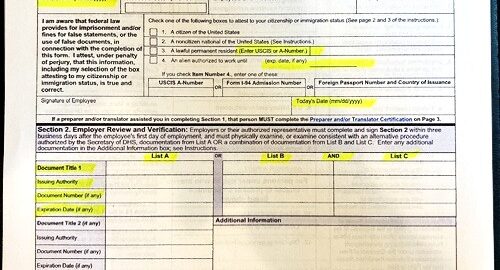
The omissions that are highlighted on the form pictured here are the errors that were classified as technical violations but are now considered substantive (penalty-worthy). Many of the boxes that I didn’t highlight have been substantive violations for years.

Under ICE’s new approach, these highlighted violations are subject to immediate fines of $288 to $2861 per form. For example, if ICE finds I-9 forms for ten of your employees are missing information that is now considered substantive, your business could be facing $2880 to $28610 in penalties.

Mistakes are Common but Costly

In my 35+ years of full-time employment law practice, I don’t think I’ve ever seen an employer whose I-9 forms on all current employees and former employees who have left in the last year (or in the last three years, depending on length of tenure) are completely correct. Whether the business owner left the process to a busy manager, an untrained HR director, or even an online service, mistakes and omissions are extremely common.

In the past, businesses relied on a good faith defense when errors were discovered during an ICE audit. Essentially the employer in the past could say, “Yes, we made a few errors filling out the forms, but we will get those corrected immediately because our intent was to never hire someone who is ineligible to work in this country.” Employers in the past also relied on ICE’s understanding that the I-9 form has been revised more than 15 times since the Immigration Reform and Control Act was passed in 1987, and every time it gets revised, mistakes are made.

As of March 2026, your good intent, or your unconscious errors, or your delegation to an untrained assistant will not matter. If you fail to complete the I-9 form on a new employee within the required time frame (3 days), if your electronic I-9 system has audit trail problems, if you don’t reverify expired documents promptly or correctly, or you omit any of the information required by the boxes I’ve highlighted for you on the current version of the I-9 form, you can expect trouble when ICE audits your forms.

ICE Audits and Enforcement on the Rise

And ICE is zealously auditing employers in the Texas Panhandle and across the country. In the first half of 2025, ICE sent out Notices of Inspection (audit letters relating to reviewing I-9 forms) to employers at 10 times the rate that it did in 2024. Clearly the approach of the current administration is to target employers using increased fines, criminal penalties and making them into public examples to deter a perceived problem of undocumented workers finding employers willing to look the other way.

Of course, the actual problem ICE is more likely to find is employers who simply made mistakes or didn’t pay enough attention to promptly, completely and correctly filling out I-9 forms each and every time.

Steps Employers Should Take Immediately

What do employers need to do right now to prevent significant fines if ICE comes calling with a Notice of Inspection?

  • Work with an employment attorney now to conduct an internal audit and carefully and legally correct the errors.
  • Train anyone who is going to be in charge of onboarding new employees. It is crucial that the person reviewing the employee legal documents knows how to correctly complete the form and knows what to examine on the identification documents to be able to swear that the employee is eligible to work.
  • If you use an electronic I-9 system for completing and signing the form, a trained HR person still has to physically examine the documents presented by the employee. As an employer, you also need to carefully assess any audit trails created by the electronic system and assure that the system is performing properly. Don’t just take the software company’s word for it. Look at the completed forms yourself and compare the documents that were presented and then copied.  
  • If you are hiring anyone remotely, there are very stringent rules about the I-9 process. You must be enrolled in E-Verify to remotely complete an I-9 on an employee. Alternatively, any employer, whether or not enrolled in E-Verify, may designate an authorized representative (such as an attorney) to meet with and physically examine documents in person on the employer’s behalf. The employer remains responsible for any errors or omissions that the authorized representative makes. And there is a box under “Additional Information” in Section 2 of the I-9 form that must be checked if this remote verification process is used. Failure to check that box is a substantive violation as of March 2026.


(Out of date) Noncompete Agreements Banned as of September 4

Update: Almost immediately after this post went live on August 20, 2024, a federal judge in Texas issued a nationwide injunction striking down the FTC’s noncompete ban. So much for my effots to try to help employers get into compliance before the deadline! So the FTC’s ban on noncompetes is blocked for the foreseeable future. As an employer, you don’t have to send the notices mentioned below. For now, you can still enforce a current noncompetition agreement against a former employee who takes a job with a competitor or sets up a business that competes with yours. However, it would be wise to consider other ways to protect your business’s trade secrets and work product because noncompetes will continue to remain controversial and the subject of a lot of expensive litigation in the future.

As I warned you in June, earlier this year, the Federal Trade Commission issued a rule banning employee noncompete agreements. The noncompete ban goes into effect on Wednesday, September 4, 2024. Despite many pending lawsuits, no nationwide injunction has been entered yet that protects employers from this ban. So now is the time to get into compliance.

What Agreements are Banned?

The noncompete ban prohibits employers from offering or requiring employees to sign any new employment agreement on or after September 4 that restricts the employee from competing with the employer when employment ends. In addition, the FTC rule prohibits employers from enforcing noncompete agreements that are already in effect.

The FTC final rule defines a non-compete clause as “a term or condition of employment that prohibits a worker from, penalizes a worker for, or functions to prevent a worker from” seeking or accepting employment or operating a business after the conclusion of the worker’s employment.

You are allowed to require your current employees to be loyal to their employer and not compete while still working for your company. But that duty of loyalty can be explained in a policy in the handbook, rather than in an agreement that requires additional legal consideration (usually monetary) and agreement of both parties.

There is one notable exception to the FTC noncompete ban. As an employer, you cannot enter into a new noncompete with a “senior executive” beginning on September 4, 2024. But existing noncompetes with senior executives can be enforced after the deadline. The FTC’s final rule defines “senior executive” as a worker who (1) earns more than $151,164 per year, and (2) is in a “policy-making position.”

Send Required Notice to Former Employees by September 4

Perhaps the most urgent part of the FTC rule is the required notice regarding the noncompete ban that you as an employer must send out. Before September 4, employers are required to send out a notice to anyone who has previously signed a noncompete that is now unenforceable (former employees) to let them know that the agreement is unenforceable.

Continue reading (Out of date) Noncompete Agreements Banned as of September 4

New Federal Vaccine Mandate Immediately Affects Employers with 100+ Employees

The Occupational Health and Safety Administration released its new vaccine mandate as an Emergency Temporary Standard today for employers who have at least 100 employees (“large employers”). The ETS is effective on November 5, 2021, and large employers only have 60 days to fully implement their vaccination plan, so time is of the essence.

Each large employer can decide if that company is going to (1) mandate that every employee gets vaccinated (while allowing limited religious and medical exemptions) or, instead, (2) mandate that its employees have a choice between vaccination and weekly testing. However, either way, large employers have to start requiring all unvaccinated employees to be masked at all times indoors as of December 5, 2021, except when they are alone in their own closed office. The new rules are summarized here.

Here are the highlights of the Emergency Temporary Standard mandate:

Does it apply to your company?

Do you have 100 names on your payroll (full-time, part-time, temporary or seasonal workers who perform work for your company at any point on or after November 5, 2021)? If so, this ETS applies to your company. “In determining the number of employees, employers must include all employees across all of their U.S. workplaces, regardless of employees’ vaccination status or where they perform their work,” according to the FAQs released by OSHA today.

The count of employees is corporate-wide, not by individual location. Even those who are working from home are counted (although some parts of the mandate do not apply to those workers who are exclusively remote workers). Similarly, those who work exclusively outside are counted when determining if you have 100 workers, but the mandate does not apply in the same way to outside workers.

Independent contractors are not included when you are counting to 100. Neither are temporary workers that you use who are actually employed by a staffing company.

Federal contractors were already subject to a separate vaccine mandate under Executive Order 14042. Healthcare employers who receive Medicare or Medicaid funds have their own stricter vaccination ETS also released today, which does not allow for testing as an alternative to vaccination. To make it easier for all employers to comply with the differing requirements, the deadline for the federal contractor vaccination requirement has been aligned with those for the healthcare entity rule and the large employer rule. Employees falling under the any of these rules will need to have their final vaccination dose – either their second dose of Pfizer or Moderna, or single dose of Johnson & Johnson – by January 4, 2022. 

But what about Gov. Abbott’s Executive Order Saying No Vaccine Mandates in Texas?

I won’t get into all of the politics of this, but this OSHA standard preempts Gov. Abbott’s order (which he couldn’t persuade the Texas Legislature to turn into law in the last special session). The U.S. Supreme Court has already backed vaccine mandates in at least three separate instances this year. I would not count on the Supremes ruling that Gov. Abbott’s executive order will prevent OSHA from enforcing this new Emergency Temporary Standard. And you probably don’t want the exorbitant legal expense for your company to be the test case for this political pissing match between the state and the feds anyway.

What are my next steps?

Continue reading New Federal Vaccine Mandate Immediately Affects Employers with 100+ Employees

Can I Drug Test My Texas Employees for Marijuana?

As 2020 begins, many Texas employers are wondering if they can still drug test their employees for marijuana use. Several states have legalized recreational marijuana and most states allow medical marijuana. So what is a Texas employer to do?

After all, Texas sort of, kinda, decriminalized weed in the 2019 legislative session. When they legalized hemp because it is a drought-resistant agricultural crop, the Texas Legislature effectively said that cannabis with less than 0.3 percent concentration of THC, the psychoactive ingredient that gets you high, is “legal hemp”, while anything above that threshold is illegal marijuana.

However, making the determination of THC concentrations takes sophisticated equipment that the police departments and private testing labs don’t have yet. Many Texas police departments and district attorneys have announced they are not even bothering to prosecute possession of use of small amounts of marijuana. Therefore, it is, for all practical purposes, very difficult to determine if your employees are engaged in legal or illegal activities when it comes to weed.

In addition, the Texas Legislature expanded “compassionate use” (medical marijuana) in Texas, so that specialty doctors can prescribe medical marijuana to treat multiple sclerosis, Parkinson’s disease, ALS, terminal cancer, autism, and many kinds of seizure disorders. Past state law only allowed those very few patients diagnosed with intractable epilepsy to be prescribed medical cannabis products, which in Texas may only contain low levels of THC. Now, many more of your employees may be legally prescribed medical marijuana and you have to worry about violating the Americans with Disabilities Act when testing for marijuana.

Finally, CBD oil, which is a hemp-derived product, is legal in Texas and is being sold on every street corner. Unfortunately, there is little regulation of CBD products, so they may contain surprise ingredients like THC. The Fort Worth Star Telegram recently reported on lawsuit filed by a CBD consumer against a CBD oil manufacturer because he lost his truck-driving job after testing positive for marijuana when he used CBD oil for his aching back.

So do you as a Texas employer still test for marijuana? Yes, legally you still can. Think of weed like alcohol. It is may be more legal than it was before, but it can still impair your employees’ job performance and judgment, so you are entitled to know if your employee is stoned.

Continue reading Can I Drug Test My Texas Employees for Marijuana?

Employer End of the Year Tasks: W-4 and Salary Minimum

Employers must address two important employment law issues before the end of 2019:

  1. Changing the exempt status of employees making a salary of less than $35,568 per year, and
  2. Adoption of the new W-4 form.

I’ve previously explained the new salary minimum for exempt (salaried) employees. In summary, for you to legally pay an employee on salary, that employee must perform exempt duties (such as running a division of the company, performing professional work such as a CPA, or performing non-profitable office duties requiring independent discretion and judgment, such as human resources, benefits coordinator, safety director, marketing director, and others, but not secretarial or bookkeeping) and make at least the new salary minimum per week of $684.00.

If an employee of yours does not meet both of these criteria (exempt duties + salary minimum), you must pay that employee by the hour and pay overtime if the employee works more than 40 hours in any one workweek. In other words, you must change the employee to a non-exempt status under the Fair Labor Standards Act and make that person an hourly employee.

There are a few exceptions to this new salary minimum rule: teachers, doctors, lawyers and outside salespersons are not subject to the salary minimum test. There are also some very  industry-specific, narrow exceptions for taxi drivers, truck drivers, fisherman and some other strange exemptions from overtime that don’t have salary minimums. But the vast majority of workers paid on salary are affected by the requirements of the exemptions.

If you are having any difficulty deciding whether to change an employee to hourly or determining if their duties meet the tests for executive, administrative or professional jobs, please call your employment lawyer immediately to get you into compliance for the January 1, 2020 effective date on the salary minimum rule.

The other big change you as an employer should be aware of is the new W-4 form that the government released on December 5, 2019. It is supposed to be easier to use for your employees.

Here are the things you need to know about this new W-4 as you start the new year:

  • You must use this new W-4 form for any employee you hire beginning on January 1, 2020 and thereafter.
  • Any employee who wants to adjust his/her withholding on January 1, 2020 or after must use the new W-4 to make that adjustment.
  • Current employees do not have to fill out a new W-4 if they don’t want to make any changes, but should consider filling out a new one if they faced an unexpected penalty of bill last year or will have a change in 2020 such as marital status, a new baby or a change in income.
  • Employees filling out the new W-4 must complete steps 1 and 5 on the new form, but may complete steps 2, 3, and/or 4 if applicable. So if you have a new employee fill out the W-4 after New Year’s Day, just check that steps 1 and 5 are complete.
  • Because it is an unfamiliar form and because it encourages people to use the IRS’s new online Tax Withholding Estimator, you should allow employees to take the new W-4 form home so they can have some time to understand and complete it.

Employees Secretly Recording Workplace Conversations

Is it legal for one of your employees to secretly record your conversations with that worker for the employee to use as evidence in a discrimination case? If you are a Texas employer, the answer is “yes”.

Texas is a “one-party” consent state, meaning that as long as one party to the conversation knows about the recording, the recording is legal. This can lead to your employee secretly starting the video app on his smartphone in his pocket just before he walks into your office for a disciplinary meeting. He knows the conversation is being recorded, so as the supervisor, you don’t have to be informed in a one-party consent state like Texas.

More than 30 states have the one-party consent rule, while California, Washington, Florida and a few other states require that every person being recorded give permission to the recording. These “all consent” states make it impossible for a supervisor to be secretly taped when talking to an employee. Making a recording without permission in one of those all consent states can lead to both criminal liability and exclusion of the tapes as evidence in the employee’s discrimination or other lawsuit.

In Texas, however, when an employer is taped, the recordings can be material evidence when an employee sues for discrimination. The Houston Chronicle reported in 2011 that one-third of the discrimination complainants who reached out the Equal Employment Opportunity Commission office in Houston brought audio tapes from their workplace to play for the EEOC investigators.

If there is a recording with you as a supervisor using a racial slur, firing an older employee while saying that the company needs “fresh and energetic workers” or suggesting to a subordinate that he/she can expect a raise if the employee will accompany you to a hotel, you might as well get your checkbook and pen out now to facilitate the inevitable settlement.

Besides the obvious – THINK BEFORE YOU SPEAK, here are some other steps you as an employer can take to protect yourself and the company from employees taping all of your interaction:

  • Adopt a written policy banning recording: As of June 2018, the National Labor Relations Board has newly declared that employers may prohibit employees using recording devices and cameras at work. This is a change from a 2015 NRLB opinion that such policies had a chilling effect on employees asserting their rights to document poor working conditions. In 2018, it was decided that no-photography/no-recording rules have little impact on NLRA-protected rights and could actually improve working conditions by forcing supervisors and subordinates to have open discussions and exchanges of ideas.
  • Ask employees if they are recording: Before you have a hard discussion with an employee, such as a disciplinary warning, ask the employee if he/she is recording the conversation. Make a written note of his response (juries don’t like liars who produce recordings when they stated they weren’t taping). You can remind the employee about the company policy prohibiting such recordings. Ask the employee to set his phone on your desk so you can assure that he isn’t recording or, even better, have him leave it at his desk before coming into your office.
  • Be careful about disciplinary actions for recording: If an employee does record in your workplace, don’t automatically warn or fire that employee even if it violated your policy. You need to know what the employee recorded, so ask to listen to the tapes. If the employee did record or photograph unsafe workplace conditions, sexual propositions, racial epithets, etc., then you need to do a formal investigation and apply effective remedial measures to fix the problem the employee’s recordings uncovered. Then carefully decide with your legal counsel whether disciplining the employee who violated your recording policy could lead to an unfair labor practice, retaliation or whistleblower claim.
  • As the employer, don’t audiotape others in the workplace without consent: While you may have video cameras in the non-private areas of your workplace for safety purposes or to monitor productivity, it becomes more complicated to make audio recordings. Wiretapping (recording the conversations of others without consent when you are not a party to the discussion) is illegal under several statutes. So, you would need permission of every employee as well as the consent of every vendor or guest who comes into your business if you were going to wholesale audiotape all the interactions in your workplace. It can be done, but it is complicated to do correctly, and the wiretapping law is easily violated. And personally, in more than 30 years of practicing employment law, I’ve only seen a handful of situations where widespread audio recording was helpful to a lawsuit defense, much less positive employee relations.

Four Steps to Protect Your Company’s Secrets When Employees Leave

What can you do to protect your company secrets when Angela, your vice-president of sales, announces she is leaving your company and going to work for your competitor? Is there a way to keep Angela from telling her new employer all about your customers’ preferences, your company’s proprietary pricing, or the new business line you are exploring?

Truthfully, the day Angela announces her resignation is way too late to adequately protect your company’s most important secrets. Your efforts to safeguard your formulas, recipes, passwords, marketing plans, customer lists or other information you would like to keep confidential should have started before Angela was even hired.

There is no time like the present to begin taking at least four concrete actions if you value your business secrets:

  1. Physically protect your confidential information. Remember the urban myths that the secret recipe for KFC chicken or the formula for Coca-Cola were locked in a safe somewhere in company headquarters? According to Fox News, those are actual precautions taken by these companies. “The recipe [for Coca-Cola] lies in a vault in a downtown Atlanta SunTrust Bank vault and only two executives at a time have access to it.” As for KFC: “’Colonel Harlan Sanders’ Original Recipe eleven herbs and spices are inscribed in pencil on a yellowed piece of paper inside a Louisville, Kentucky safe’, says KFC spokesman Rick Maynard. ‘The safe lies inside a state-of-the-art vault that is surrounded by motion detectors, cameras and guards.’” Corporate espionage and theft of trade secrets is big business these days. These two food companies are serious about safeguarding their trade secrets. Are you as careful with yours?
    1. Do you at least have good password procedures, firewalls and cyberthreat protection, files marked “confidential”, inventories of your laptops and other equipment, and limitations on which employees have access to the keys to your business kingdom?
    2. Do you teach your new employees what information is confidential, how to protect it, remind employees frequently about their confidentiality obligations, and take immediate action if there is any breach in confidentiality?
    3. Do you prevent employees from downloading company documents onto flash drives or leaving the premises with your files?
    4. If you don’t take serious measures to protect your trade secrets, you really shouldn’t expect your current or departing employees to care either. Plus, the new Texas Uniform Trade Secrets Act doesn’t even recognize information as a trade secret unless the owner can demonstrate that the business has taken reasonable measures to keep the information secret. So without active measures to protect the secrecy of your proprietary information, you are helpless in the courts when your secrets are stolen.

Continue reading Four Steps to Protect Your Company’s Secrets When Employees Leave

Best Employment Law Training To Be Offered in Amarillo

One of the best employment law training opportunities for managers, human resources personnel and business owners of your company is happening in Amarillo on September 21, 2018.

The Texas Workforce Commission only offers its Texas Business Conference in Amarillo every few years and I recommend it to my clients as a “not to be missed” event. The cost is only $125 per person and just the written materials you will receive at the one-day conference are worth that.

The TWC’s speakers will cover the following in detail:

  • Wage and Hour Law (which is arguably the most violated business law in the country);
  • Independent Contractors;
  • Policies and Handbooks;
  • Worker’s Compensation: How to Control Costs of an On the Job Injury;
  • Hiring/Employment Law Update; and
  • Unemployment Claims and Appeals.

The great news is that the conference will help you no matter whether you are new to human resources issues or have been dealing with them forever.  I’ve been practicing employment law for 30 years, yet I learn something new every time I attend this conference.

If you would like to sign up for this training event, you can find more information and registration here. I hope I see you there on September 21.

Employee Handbook Policies You Can and Cannot Legally Include

For the last several years, the National Labor Relations Board has been regulating which policies your employee handbook can and cannot include, even in your non-unionized workplace. At one point in 2015, there were dozens of handbook policies that were considered to have a chilling effect on an employee’s freedom to organize through “concerted activity”. Those policies were ruled to violate the National Labor Relations Act and as an employment lawyer, when I encountered them in a client’s employment policy manual, I either removed them or added a disclaimer stating that the policies weren’t intended to apply to acts protected by the NLRA.

Three years have passed and several court opinions have frowned on the NLRB’s formerly expansive disapproval regarding employee policies. In addition, the political leanings at the NLRB have shifted. Therefore, a distinctive change has recently occurred in the NLRB’s approach as to which employee policies an employer can enforce and which ones an employer can’t.

In a general counsel’s memo dated June 6, 2018, the NLRB instructed its staff that the following policies are okay to include in an employer’s policy manual and won’t necessarily be treated as an unfair labor practice:

  • Civility rules that require employees to avoid disparaging coworkers and using offensive, rude or condescending language to a coworker or customer;
  • Rules requiring that proprietary information and trade secrets of the employer and confidential information of customers have to be protected by employees (however, just saying everything the employee learns at work is confidential is too broad);
  • Rules prohibiting employees from aiding the competition, self-dealing and nepotism;
  • Rules against insubordination or non-cooperation that affects company operations (usually described as refusal to comply with a supervisor’s orders and/or perform work);
  • Rules prohibiting employees making intentionally dishonest statements or misrepresentations;
  • Rules prohibiting disruptive behaviors, such as “fighting, roughhousing, horseplay, tomfoolery, and other shenanigans.” Also included on the naughty list: “yelling, profanity, hostile or angry tones, throwing things, slamming doors, waving arms or fists, verbal abuse, destruction of property, threats, or outright violence.”
  • Rules prohibiting photography or recording in most business settings. “Employers have a legitimate and substantial interest in limiting recording and photography on their property. This interest may involve security concerns, protection of property, protection of proprietary, confidential, and customer information, avoiding legal liability, and maintaining the integrity of operations,” said the 2018 NLRB General Counsel. So, on balance, the NLRB has decided that it is okay for your policy to tell your employees “no photography, no recording”.

But that doesn’t mean that every rule in your employee handbook is acceptable. You still have to consider if your written policy is infringing on your employees’ rights to participate in protected concerted activity—the joining together of employees to discuss or protest the terms and conditions of their employment. If so, by enforcing that policy, you may be committing an unfair labor practice and you can be investigated and penalized by the NRLB.

Here are five policies that your employee policy manual that are still problematic and could get your company into trouble: Continue reading Employee Handbook Policies You Can and Cannot Legally Include

10 Facts Texas Employers Should Know About Unemployment

Do I have to pay unemployment on my employee who just quit/resigned/got fired/was laid off?

During most of my thirty years as an employment lawyer, I have been asked that question at least once a week. Here are ten basic facts that every employer in Texas needs to understand about our state’s unemployment system: Continue reading 10 Facts Texas Employers Should Know About Unemployment