Category Archives: Hiring

Pay Attention to I-9 Forms

The I-9 form, on which an employer has to certify that every new employee is eligible to legally be employed in the United States, requires significantly more attention than most employers pay to it. Fill it in casually, inattentively or incorrectly, and that form could cost an employer thousands of dollars per employee.

Missing I-9 Information Leads to Penalties

The Trump Administration recently increased the stakes for employers who are careless with completing I-9 forms. On March 16, 2026, ICE determined in a fact sheet (without notice or proposed rulemaking) that it would treat most missing information on the form as a “substantive violation” rather than a “technical violation.”

In government-speak, that means that an employer who does not assure that the form gets filled out completely and correctly each and every time a new employee is hired faces monetary penalties without any opportunity to cure the minor defects first.

For 30 years, technical violations, such as accidentally missing the employee’s date of birth in Section 1, required that the employer correct the error when it was discovered during an ICE audit. The employer had 10 business days to correct the form and then no penalty was assessed.

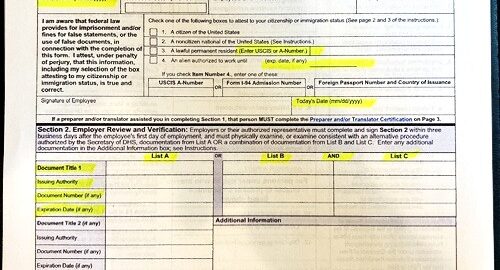
The omissions that are highlighted on the form pictured here are the errors that were classified as technical violations but are now considered substantive (penalty-worthy). Many of the boxes that I didn’t highlight have been substantive violations for years.

Under ICE’s new approach, these highlighted violations are subject to immediate fines of $288 to $2861 per form. For example, if ICE finds I-9 forms for ten of your employees are missing information that is now considered substantive, your business could be facing $2880 to $28610 in penalties.

Mistakes are Common but Costly

In my 35+ years of full-time employment law practice, I don’t think I’ve ever seen an employer whose I-9 forms on all current employees and former employees who have left in the last year (or in the last three years, depending on length of tenure) are completely correct. Whether the business owner left the process to a busy manager, an untrained HR director, or even an online service, mistakes and omissions are extremely common.

In the past, businesses relied on a good faith defense when errors were discovered during an ICE audit. Essentially the employer in the past could say, “Yes, we made a few errors filling out the forms, but we will get those corrected immediately because our intent was to never hire someone who is ineligible to work in this country.” Employers in the past also relied on ICE’s understanding that the I-9 form has been revised more than 15 times since the Immigration Reform and Control Act was passed in 1987, and every time it gets revised, mistakes are made.

As of March 2026, your good intent, or your unconscious errors, or your delegation to an untrained assistant will not matter. If you fail to complete the I-9 form on a new employee within the required time frame (3 days), if your electronic I-9 system has audit trail problems, if you don’t reverify expired documents promptly or correctly, or you omit any of the information required by the boxes I’ve highlighted for you on the current version of the I-9 form, you can expect trouble when ICE audits your forms.

ICE Audits and Enforcement on the Rise

And ICE is zealously auditing employers in the Texas Panhandle and across the country. In the first half of 2025, ICE sent out Notices of Inspection (audit letters relating to reviewing I-9 forms) to employers at 10 times the rate that it did in 2024. Clearly the approach of the current administration is to target employers using increased fines, criminal penalties and making them into public examples to deter a perceived problem of undocumented workers finding employers willing to look the other way.

Of course, the actual problem ICE is more likely to find is employers who simply made mistakes or didn’t pay enough attention to promptly, completely and correctly filling out I-9 forms each and every time.

Steps Employers Should Take Immediately

What do employers need to do right now to prevent significant fines if ICE comes calling with a Notice of Inspection?

  • Work with an employment attorney now to conduct an internal audit and carefully and legally correct the errors.
  • Train anyone who is going to be in charge of onboarding new employees. It is crucial that the person reviewing the employee legal documents knows how to correctly complete the form and knows what to examine on the identification documents to be able to swear that the employee is eligible to work.
  • If you use an electronic I-9 system for completing and signing the form, a trained HR person still has to physically examine the documents presented by the employee. As an employer, you also need to carefully assess any audit trails created by the electronic system and assure that the system is performing properly. Don’t just take the software company’s word for it. Look at the completed forms yourself and compare the documents that were presented and then copied.  
  • If you are hiring anyone remotely, there are very stringent rules about the I-9 process. You must be enrolled in E-Verify to remotely complete an I-9 on an employee. Alternatively, any employer, whether or not enrolled in E-Verify, may designate an authorized representative (such as an attorney) to meet with and physically examine documents in person on the employer’s behalf. The employer remains responsible for any errors or omissions that the authorized representative makes. And there is a box under “Additional Information” in Section 2 of the I-9 form that must be checked if this remote verification process is used. Failure to check that box is a substantive violation as of March 2026.

Out-of-State Employees Have to be Treated Differently

As a Texas employer, your employees in other states are protected by the laws of the state in which they perform their work, not Texas law. In most cases, those laws give your out-of-state workers more rights and protections than employees in Texas are given.

As a rule of thumb, the state and local laws of the physical location where the employee is working will supersede Texas law. That means that Texas businesses are responsible for complying with the laws of those other states when they employ a worker across the Texas state lines.

Many of my business clients are headquartered in the Texas Panhandle, but they also have operations, offices, clients and therefore, employees, in New Mexico, Oklahoma, Kansas, Colorado or other states. In an attempt to simplify their operations, those multi-state employers often prefer to adopt policies that apply across the board to all employees, regardless of where the employee is located.

But you cannot ignore the employment laws of the state in which your employees reside and perform some work, even if they only work in that state part of the time. While it is impossible to list every different employment law for even just the nearby states, here are just some examples that employers need to be aware of:

Continue reading Out-of-State Employees Have to be Treated Differently

Get Ready for Immigration Enforcement Spotlight

When President-elect Trump takes office next week, he has promised to launch what his aide Stephen Miller called a “shock and awe blitz” of executive orders and actions that will target millions of immigrants and their families. Employers need to be ready to respond to this renewed emphasis on immigration enforcement.

History of Raids on Businesses

Will there be a return to the kinds of raids on businesses that we saw during President Bush’s second term? Time Magazine reported that President-Elect Trump told the magazine in an interview that he wants a return to United States Customs and Immigration Enforcement (“ICE”) raids of businesses. “The strategy, which he also ramped up in his first term, aims to increase the visibility and enforcement of immigration laws in everyday settings, targeting industries that frequently employ unauthorized workers. Trump has suggested that these raids will not only deter unauthorized employment but also lead to significant labor market shifts, benefiting American workers,” Time reported.

For those who don’t remember one of the most infamous ICE enforcement actions during President Bush’s administration, in December 2006, the giant meatpacking plant formerly owned by Swift and now owned by JBS in the Texas Panhandle town of Cactus, was one of the targets of the largest single-site workforce enforcement action in U.S. history. ICE officers in riot gear and armed with assault rifles arrested nearly 300 workers, more than 10% of the population of Cactus. School children were left with no one to pick them up or care for them at home because both parents were arrested in the raid. The community of Cactus was decimated. Seven months later, ICE batted clean up by conducting another, smaller raid on the same plant in Cactus.

The town of Cactus eventually recovered, but the JBS plant is still almost completely staffed by immigrants, some of whom may be at risk if another raid occurs. Many noncitizen workers there are hired to come to the U.S. to work on legal visas, but President Trump has threated even those migrants who are in the country legally, despite that fact that many workers born in the United States don’t seem to want the jobs offered at JBS. If enforcement actions are actively pursued by ICE in Cactus or elsewhere, it will be up to the employer to prove that each of its workers is legally eligible for employment in the United States.

Holding Business Owners and Managers Responsible

After the furor that such raids caused during the Bush administration, President Obama took a different tact. His administration pursued the employers, not the workers. Some  of the 1100 criminal arrests ICE made in 2008 resulted in charges against owners, managers, supervisors or human resources directors who knowingly hired ineligible workers, failed to diligently check employment eligibility or just ignored the requirements.

The owners and managers of the businesses were targeted because it is the employer’s responsibility to certify that each employee is eligible to legally work in the United States. This is done by reviewing the employee’s eligibility documentation (such as passports, work permits, social security cards, driver’s licenses, etc.) within the first three days of employment and properly completing the Form I-9 to show compliance.

How Employers Can Prepare Now

Let’s say that you don’t believe that you employ any ineligible workers. You may still have documentation problems. Just for incorrectly completing the  I-9’s, even if your workers are all actually eligible to work in the United States, you can be fined up to $2789 per worker.

Continue reading Get Ready for Immigration Enforcement Spotlight

(Out of date) Noncompete Agreements Banned as of September 4

Update: Almost immediately after this post went live on August 20, 2024, a federal judge in Texas issued a nationwide injunction striking down the FTC’s noncompete ban. So much for my effots to try to help employers get into compliance before the deadline! So the FTC’s ban on noncompetes is blocked for the foreseeable future. As an employer, you don’t have to send the notices mentioned below. For now, you can still enforce a current noncompetition agreement against a former employee who takes a job with a competitor or sets up a business that competes with yours. However, it would be wise to consider other ways to protect your business’s trade secrets and work product because noncompetes will continue to remain controversial and the subject of a lot of expensive litigation in the future.

As I warned you in June, earlier this year, the Federal Trade Commission issued a rule banning employee noncompete agreements. The noncompete ban goes into effect on Wednesday, September 4, 2024. Despite many pending lawsuits, no nationwide injunction has been entered yet that protects employers from this ban. So now is the time to get into compliance.

What Agreements are Banned?

The noncompete ban prohibits employers from offering or requiring employees to sign any new employment agreement on or after September 4 that restricts the employee from competing with the employer when employment ends. In addition, the FTC rule prohibits employers from enforcing noncompete agreements that are already in effect.

The FTC final rule defines a non-compete clause as “a term or condition of employment that prohibits a worker from, penalizes a worker for, or functions to prevent a worker from” seeking or accepting employment or operating a business after the conclusion of the worker’s employment.

You are allowed to require your current employees to be loyal to their employer and not compete while still working for your company. But that duty of loyalty can be explained in a policy in the handbook, rather than in an agreement that requires additional legal consideration (usually monetary) and agreement of both parties.

There is one notable exception to the FTC noncompete ban. As an employer, you cannot enter into a new noncompete with a “senior executive” beginning on September 4, 2024. But existing noncompetes with senior executives can be enforced after the deadline. The FTC’s final rule defines “senior executive” as a worker who (1) earns more than $151,164 per year, and (2) is in a “policy-making position.”

Send Required Notice to Former Employees by September 4

Perhaps the most urgent part of the FTC rule is the required notice regarding the noncompete ban that you as an employer must send out. Before September 4, employers are required to send out a notice to anyone who has previously signed a noncompete that is now unenforceable (former employees) to let them know that the agreement is unenforceable.

Continue reading (Out of date) Noncompete Agreements Banned as of September 4

Employer’s Background Checking Obligations

As most local employers know, hiring is hard right now. There are very few applicants and some of those who apply disappear during the hiring process by missing an interview or ghosting your emails and calls.

But don’t let the difficulty of filling an open position tempt you to skip important steps in the hiring process, particularly criminal background checks.

Knowing if your potential employee has a criminal background can prevent many problems down the road. And for some employers in Texas, it is actually required by law. For example, childcare workers must be checked for criminal pasts.

In-Home Service and Residential Delivery Employee Background Checking

But the requirement that gets ignored too often is a Texas employer’s obligation to screen any employee who will be going into residences or into residential garages, outbuildings, etc. So if you operate a furniture store that delivers to customers’ homes, if your employees access houses to repair air conditioners, electrical, appliances or plumbing, if you provide home health services, if you remodel homes, or if your company performs any other jobs in customers’ residences, your business is required to obtain a background check on every employee who will perform those residential services.

Here is the Texas Workforce Commission’s explanation and recommendation:

In-home service and residential delivery companies must perform a complete criminal history background check through DPS or a private vendor on any employees or associates sent by the companies into customers’ homes (including attached garages or construction areas next to homes), or else confirm that the persons sent into customers’ homes are licensed by an occupational licensing agency that conducted such a criminal history check before issuing the license. The records must show that during the past 20 years for a felony, and the past 10 years for a class A or B misdemeanor, the person has not been convicted of, or sentenced to deferred adjudication for, an offense against a person or a family, an offense against property, or public indecency. A check done in compliance with these requirements entitles the person’s employer to a rebuttable presumption that the employer did not act negligently in hiring the person. See the Texas Civil Practice and Remedies Code, Sections 145.002-145.004Recommended: do such checks on anyone who will be going into a person’s home, garage, yards, driveways, or any other areas where the employee could come into contact with people at their homes.

Note that this law requires that you look at crimes committed in the last 10-20 years, while both federal and Texas law prohibit commercial background screening services reporting a criminal past if the date of disposition, release, or parole predates the consumer report by more than seven years. Tex. Bus. & Comm. Code §20.05(a)(4). So you could technically check a background using a commercial service and still not discover that your applicant assaulted someone 15 years ago, even if your business is required to check 20 years of felony records for residential repairpersons.

Continue reading Employer’s Background Checking Obligations

How to Hire and Retain During the “Big Quit”

Almost daily, my employer clients are telling me about their inability to hire workers to fill job openings in the Texas Panhandle. This local trend reflects a nationwide problem. The Bureau of Labor Statistics just reported last week that 4.3 million people left their jobs in August 2021, the highest “quits rate” since the BLS started tracking the numbers in 2001.  

Industries that were most affected by this high quits rate in August included hotels, bars, restaurants, retail, manufacturing, construction, healthcare and education. The media has dubbed this as the “Great Resignation” or the snappier “Big Quit”.

We knew this was coming even before the BLS released that report on October 12. Surveys by Microsoft and by the Society for Human Resource Management earlier this year both found that 40% of employees say they have or will quit their jobs in 2021. That’s double the number in 2019, just before the pandemic.

There are lots of reasons why employees are participating in the “Big Quit” and employers are having such a challenging time filling open positions. But the reasons are not solely, or even chiefly, related to government handouts. Ending the federal supplement to unemployment in Texas and other states at the end of June 2021 didn’t create any improvement in employers’ ability to hire. In fact, the recent BLS numbers showed that employees walking away from their jobs markedly increased after the unemployment benefits expired.

Reasons for the Big Quit

The reasons for the Great Resignation seem to be related to what employees discovered about themselves and their jobs during the pandemic:

  • More than four million Americans dropped out of the labor force entirely during the pandemic, particularly women and workers over 55 years old. They had reasons ranging from childcare duties, to early retirement, to concerns about contracting COVID. Sixty-eight percent of workers who told SHRM that they were going to quit their jobs in 2021 said that they decided to make a change during the COVID-19 pandemic. Extended time at home has convinced many workers that they are dissatisfied with their current career and would rather transition to being a stay-at-home parent, pursue a new educational opportunity, look for a better job or retire.
  • A huge wave of Baby Boomers retired, many because of unpaid furloughs during the pandemic. But a year later, even more are retiring, reporting that they have reached the point of exhaustion and will be happier if they leave the workplace altogether, even if it means a less healthy retirement income. The estimate is that 10,000 Boomers retire each day in the US, and because the following generations are smaller, finding and retaining replacements for the Boomers is proving difficult and a long-term problem, projected to continue for the next 10-15 years.
  • Restaurant staff, grocery store employees, delivery drivers, heathcare workers, teachers, retail workers and others reached their breaking points. “Throughout the pandemic, essential workers – often in lower paid positions – have borne the brunt of employers’ decisions. Many were working longer hours on smaller staffs, in positions that required interaction with the public with little to no safety measures put in place by the company and, at least in the US, no guarantee of paid sick leave. It quickly burnt workers out,” concluded a BBC report.
  • Low wages are a hugely motivating factor in the Great Resignation. The federal (and Texas) minimum wage hasn’t increased above $7.25 since 2009, even though the consumer prices have. An item that cost $7.25 in 2009 now costs $9.27 in 2021. Employees who make these minimum wage know that they sink further into poverty every year, and they are running away from low paying jobs as fast as possible.
  • The SHRM survey found that 53% of the people leaving their jobs in 2021 did it for better compensation. Employees who are stressed and in low satisfaction jobs with irregular schedules like food service don’t have to perform that work anymore for the low wages that employers were paying before the Big Quit. “Workers’ wages are rising at the fastest pace in years, due largely to structural shifts in labor markets, talent supply challenges and potential inflation.  Research shows 72% of companies are updating pay and benefits programs in 2021 to address multiple challenges”, according to Forbes.  

This kind of massive reorganization of the labor market happens after world wars and economic recessions. The COVID pandemic has apparently created the same type of seismic shift where it is a seller’s market for employees to demand and receive better employment perks in exchange for agreeing to perform the work.

So what should a Texas Panhandle employer do to improve recruiting of employees for all those open positions in 2021?

Continue reading How to Hire and Retain During the “Big Quit”

Supreme Court Outlaws Discrimination Against LGBT Employees

The United State Supreme Court ruled today in Bostock v. Clayton County that employers may be sued for sex discrimination by LGBT employees under Title VII of the Civil Rights Act of 1964. This opinion resolves a long-time disagreement between the various federal circuit courts and unwieldy patchwork of laws that had protected LGBT employees in some states but not others, and Texas cities like Austin, Dallas and Houston, but not Amarillo.

The Court combined three cases, one in which a male county employee was fired for conduct “unbecoming” a public employee when he joined a gay softball league, one in which a private employer fired an employee just days after he mentioned he was gay, and one where a funeral home fired an employee who presented as male when hired, but later stated that she was going to live, dress and work as a female going forward.

After reviewing each of these job terminations, the Court decided 6-3 in an opinion written by Trump-appointee Justice Neil Gorsuch that an employer who fires an individual based in part on being gay or transgender (and by natural extension, bisexual or lesbian) violates Title VII’s prohibition on discrimination on the basis of sex. “An employer who fires an individual merely for being gay or transgender defies the law”, Gorsuch wrote.

The Court pointed out several important rules for employers to know (these apply to any discriminatory job decision, whether it is based on race, age, national origin, disability, religion, etc.):

Continue reading Supreme Court Outlaws Discrimination Against LGBT Employees

Hiring Focused on Character

I often hear the general perception by business owners and managers that employees under the age of 30 have a lousy work ethic or other character deficiencies. They complain about entry-level employees who aren’t interested in paying their dues and are convinced they are entitled to move into the corner office on the day they are hired. I also hear about inappropriate dress, lack of loyalty and attendance woes among young people. But I know many “kids” under 30 (my 26-year-old son among them) who are incredibly motivated, hard-working, smart and willing to pay their dues.

Throughout my 32 years of practicing employment law full-time, I’ve also heard lots of similar stereotypical complaints about women in the workplace (“they can’t get along with other women—it’s always a cat fight” or “they just quit when they have children”). And sometimes, I have unfortunately been privy to pure misogyny, racism, ageism, and other bigotry when discussing problem employees.

I have a radical observation from more than 30 years of practicing employment law: Character is not generational, racial or gender-specific. I’ve worked with some terrific young employees and some terrible older ones, some unbelievably hard-working women and some slacker men, some brilliant minorities and some completely ignorant WASPs. The real debate is not about an employee’s age, race, gender or any other data point over which the employee has no control, but the employee’s individual character. So I encourage employers to focus on character more and stereotypes less (actually, not at all).

As an employer, I know you want to fill any open position with an employee who will exhibit responsibility, honesty, loyalty, enthusiasm, flexibility, initiative, dependability, civility, judgment and a distinct sense of right and wrong, regardless of their gender, ethnicity, age, or other protected characteristic.

You won’t find nearly as many business books that focus on character instead of generational conflict or the “downfalls” of diversity. The subject of character often sounds old-fashioned and faintly religious.

But all of us have reluctantly dealt with people with poorly-developed values: gossips, drama queens, whiners, liars, cheats, etc. There is no reason to have those kinds of people working for you and it is not illegal to refuse to hire them. But you have to be able to spot poor character in your hiring process to avoid bringing this poison into your workplace.

To hire better employees, first identify the character traits that are most important to you. Think back about what really disappointed or angered you about the personalities of unsuccessful employees in the past. Were they always tardy? Then dependability is very important to you. Did they steal company time by shopping on the internet on the company computer for hours a day? Then honesty and productivity are probably high on your list. Did your former employee pot-stir, pitting employees against one another? Then you are looking for someone who treats everyone with respect and doesn’t enjoy gossip.

Design an employment process that doesn’t just focus on job skills, but also zeroes in on the character traits that matter most to you. Ask open-ended questions about values in the interview, but don’t rely solely on your ability to judge character. No hour-long interview is going to tell you everything about an applicant’s character.

But you can find out some aspects of an applicant’s character if you ask about:

Continue reading Hiring Focused on Character

“Go Back” Comments Are Unlawful in Workplace

Telling a person in America to “go back to where you came from” has been considered racist and bigoted for decades in this country founded and built by immigrants, and if you as an employer allow this sentiment to ever be expressed at your business, you can expect a racial or national origin discrimination lawsuit to quickly follow.

Regardless of how the current occupant of the White House talks, the Equal Employment Opportunity Commission (“EEOC”), which actually investigates and prosecutes discrimination/harassment claims, has long told employers:

Ethnic slurs and other verbal or physical conduct of nationality are illegal if they are severe or pervasive and created an intimidating, hostile or offensive working environment, interfere with work performance, or negatively affect job opportunities. Examples of potentially unlawful conduct includes insults, taunting, or ethnic epithets, such as making fun of a person’s foreign accent or comments like, “Go back to where you came from,” whether made by supervisors or by co-workers.

Facts About Employment Rights of Immigrants Under Federal Anti-Discrimination Laws, U.S. Equal Employment Opportunity Commission.

The EEOC didn’t come up with this guidance on its own. It followed dozens of court opinions that examined cases in which an employee was harassed with statements like, “Go back to Africa” addressed to a black worker or “Go back to where you came from” addressed to an employee who appeared to the bigot to have been born somewhere other than America.

For example, our own conservative Fifth Circuit Court of Appeals ruled in a summary judgment appeal in EEOC v. WC&M Enterprises, Inc., 496 F.3d 396 (5th Cir. 2007) that an employee born in India (“Rafiq”), who happened to be Muslim, was entitled to prove he was harassed in a severe and pervasive way when his coworkers and managers said, “Why don’t you just go back where you came from”, started calling him “Taliban,” after September 11, and repeatedly referred to him as an Arab (he was Indian).

Rafiq was told, “This is America. That’s the way things work over here. This is not the Islamic country where you came from.” Rafiq’s supervisor even put in a written warning that Rafiq was “acting like a Muslim extremist” and said he could no longer work with Rafiq because of his “militant stance”. The Fifth Circuit found that a jury could “easily infer that [the coworkers’ and supervisor’s] actions were taken on account of Rafiq’s religion and national origin.”

One way the company tried to defend itself was by saying that it couldn’t have discriminated against Rafiq on the basis of national origin, since the workers were apparently too clueless to understand the difference between India and Saudi Arabia or whichever other Muslim country they mistakenly believed Rafiq was from. “The fact that the coworker ignorantly used the wrong derogatory ethnic remark toward the plaintiff is inconsequential.” LaRocca v. Precision Motorcars, Inc., 45 F. Supp.2d 762, 770 (D. Neb. 1999). The Fifth Circuit agreed and concluded in Rafiq’s case, “It is enough to show that the complainant was treated differently because of his or her foreign accent, appearance or physical characteristics.”

As the Sixth Circuit Court of Appeals has said, telling someone to “go back to where you came from” is “insensitive, ignorant and bigoted.” Williams v. CSX Transportation Co. Inc., 643 F.3d 502 (6th Cir. 2011). It is your responsibility as an employer to make sure that words to that effect aren’t uttered in your workplace, particularly, but not exclusively, if they are said by anyone in management. “The employer is presumed absolutely liable where harassment is perpetrated by the victim’s supervisor.” Nader v. The Brunalli Construction Co., 2009 WL 724597 (D. Conn. 2002).  

So how do you as an employer assure that this kind of discriminatory and harassing talk isn’t heard in your workplace?

Continue reading “Go Back” Comments Are Unlawful in Workplace

Paid Sick Leave Required in Some Texas Cities

Do you as an employer provide your employees in Texas at least six to eight days of paid sick leave every year? If you have employees who work in Dallas or San Antonio, you are about to be required to do so. You should be immediately adding a paid sick leave policy that complies with municipal ordinances that take effect August 1, 2019 in those two cities.

If you have an employee who works at least 80 hours per year in the city limits of Dallas or San Antonio, the new ordinances require you as the employer (if you employ five or more people anywhere) to provide that employee with one hour of paid sick leave for every 30 hours that the employee works within those city limits. It doesn’t matter if your business isn’t based in one of those cities, just whether your employee performs work there.

Of course, offering this paid sick leave only to your employees who work in San Antonio and Dallas could create workforce animosity and claims of discrimination among your other employees, so employers making changes to their policies need to carefully consider whether a company-wide sick leave policy revision is the smartest move at this point.

Here are the general details of the two municipal paid sick leave ordinances in Dallas and San Antonio. You should ask your employment lawyer to help you include the specifics in your revised written sick leave policy if you have Dallas and San Antonio workers:

  • If you have 15 or more employees, then you must allow your Dallas and San Antonio employees to accrue at least 64 hours of sick leave per year. For smaller employers (5-14 employees employed anywhere), the total amount of paid sick leave required per year is 48 hours.
  • The paid sick leave laws apply to full and part-time employees, so those of you who don’t provide benefits to part-time employees in Dallas and San Antonio will need to revise your policies.
  • These ordinances say that employees can use their paid sick leave as soon as it is accrued. So if you require an initial probationary or orientation period in which paid time off can’t be used, you’ll have to rethink your policy in that regard.
  • This paid sick leave can be used for more than employee’s own mental or physical health problems. The employee can take the paid time off for a family member’s illnesses, any family member’s victimization (such as domestic violence or sexual assault), and for doctor’s appointments for the employee or a family member. “Family member” is defined broadly and includes blood relatives as well as anyone who has such a close association with the employee to be considered family (such as a live-in partner).
  • You have to allow carry over of accrued but unused paid sick leave to the next year if you use the accrual method. However, if you provide all of the paid sick leave the employee will be entitled to at the beginning of the year, then you don’t have to allow carry over (this is also much easier to administer than the accrual method).
  • You can’t retaliate against an employee for using the sick leave he/she is entitled to.
  • Enforcement won’t go into full effect on these ordinances until April 2020, but you should be amending your policies now to comply with the August 1, 2019 effective date.

These ordinances have not been without controversy. The business lobby in Texas is fighting hard against these paid sick leave laws. A similar one in Austin is currently enjoined by a court battle, headed to the Texas Supreme Court, and won’t be taking effect as scheduled. But the court battle will take significant time and the 2019 Texas Legislative session ended last month with the lawmakers failing to pass any bill to standardize these municipal ordinances statewide or prohibit cities from passing them, so there is little chance that Dallas and San Antonio’s laws won’t go into effect in August, even if they are challenged in court later.

Even if you don’t have Dallas and San Antonio employees, I think all Texas employers must consider offering paid sick leave right now. Not only are states and cities all over the country requiring this, but employees are coming to expect this benefit.

Plus such a change can benefit an employer in a time of historically low unemployment in this state. It seems that almost every employer that I represent tells me that he/she can’t hire and keep good help. So shouldn’t you be offering some kind of paid sick leave to improve your hiring and retention? Maybe it would be helpful to adopt a policy that would comply with these city ordinances as part of a more comprehensive review and beefing up of your benefits to attract and retain high-quality employees.

Even Walmart (long regarded as one of America’s worst employers) recognized in 2019 the value of providing its hourly employees with 48 hours of paid sick leave per year in addition to regular paid time off. In fact, Walmart’s new company-wide paid sick leave policy looks surprisingly similar to the ordinances just passed by Dallas and San Antonio. Walmart wasn’t being altruistic, of course. It just made the move to standardize its policies to comply with a nationwide patchwork of new state and municipal laws requiring employers provide paid sick leave.