The I-9 form, on which an employer has to certify that every new employee is eligible to legally be employed in the United States, requires significantly more attention than most employers pay to it. Fill it in casually, inattentively or incorrectly, and that form could cost an employer thousands of dollars per employee.
Missing I-9 Information Leads to Penalties
The Trump Administration recently increased the stakes for employers who are careless with completing I-9 forms. On March 16, 2026, ICE determined in a fact sheet (without notice or proposed rulemaking) that it would treat most missing information on the form as a “substantive violation” rather than a “technical violation.”
In government-speak, that means that an employer who does not assure that the form gets filled out completely and correctly each and every time a new employee is hired faces monetary penalties without any opportunity to cure the minor defects first.
For 30 years, technical violations, such as accidentally missing the employee’s date of birth in Section 1, required that the employer correct the error when it was discovered during an ICE audit. The employer had 10 business days to correct the form and then no penalty was assessed.
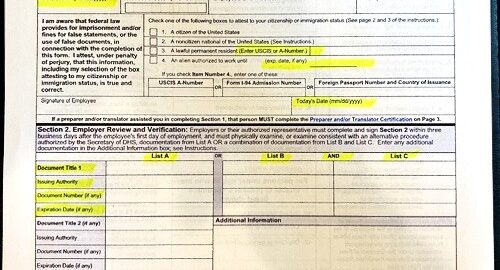
The omissions that are highlighted on the form pictured here are the errors that were classified as technical violations but are now considered substantive (penalty-worthy). Many of the boxes that I didn’t highlight have been substantive violations for years.
Under ICE’s new approach, these highlighted violations are subject to immediate fines of $288 to $2861 per form. For example, if ICE finds I-9 forms for ten of your employees are missing information that is now considered substantive, your business could be facing $2880 to $28610 in penalties.
Mistakes are Common but Costly
In my 35+ years of full-time employment law practice, I don’t think I’ve ever seen an employer whose I-9 forms on all current employees and former employees who have left in the last year (or in the last three years, depending on length of tenure) are completely correct. Whether the business owner left the process to a busy manager, an untrained HR director, or even an online service, mistakes and omissions are extremely common.
In the past, businesses relied on a good faith defense when errors were discovered during an ICE audit. Essentially the employer in the past could say, “Yes, we made a few errors filling out the forms, but we will get those corrected immediately because our intent was to never hire someone who is ineligible to work in this country.” Employers in the past also relied on ICE’s understanding that the I-9 form has been revised more than 15 times since the Immigration Reform and Control Act was passed in 1987, and every time it gets revised, mistakes are made.
As of March 2026, your good intent, or your unconscious errors, or your delegation to an untrained assistant will not matter. If you fail to complete the I-9 form on a new employee within the required time frame (3 days), if your electronic I-9 system has audit trail problems, if you don’t reverify expired documents promptly or correctly, or you omit any of the information required by the boxes I’ve highlighted for you on the current version of the I-9 form, you can expect trouble when ICE audits your forms.
ICE Audits and Enforcement on the Rise
And ICE is zealously auditing employers in the Texas Panhandle and across the country. In the first half of 2025, ICE sent out Notices of Inspection (audit letters relating to reviewing I-9 forms) to employers at 10 times the rate that it did in 2024. Clearly the approach of the current administration is to target employers using increased fines, criminal penalties and making them into public examples to deter a perceived problem of undocumented workers finding employers willing to look the other way.
Of course, the actual problem ICE is more likely to find is employers who simply made mistakes or didn’t pay enough attention to promptly, completely and correctly filling out I-9 forms each and every time.
Steps Employers Should Take Immediately
What do employers need to do right now to prevent significant fines if ICE comes calling with a Notice of Inspection?
- Work with an employment attorney now to conduct an internal audit and carefully and legally correct the errors.
- Train anyone who is going to be in charge of onboarding new employees. It is crucial that the person reviewing the employee legal documents knows how to correctly complete the form and knows what to examine on the identification documents to be able to swear that the employee is eligible to work.
- If you use an electronic I-9 system for completing and signing the form, a trained HR person still has to physically examine the documents presented by the employee. As an employer, you also need to carefully assess any audit trails created by the electronic system and assure that the system is performing properly. Don’t just take the software company’s word for it. Look at the completed forms yourself and compare the documents that were presented and then copied.
- If you are hiring anyone remotely, there are very stringent rules about the I-9 process. You must be enrolled in E-Verify to remotely complete an I-9 on an employee. Alternatively, any employer, whether or not enrolled in E-Verify, may designate an authorized representative (such as an attorney) to meet with and physically examine documents in person on the employer’s behalf. The employer remains responsible for any errors or omissions that the authorized representative makes. And there is a box under “Additional Information” in Section 2 of the I-9 form that must be checked if this remote verification process is used. Failure to check that box is a substantive violation as of March 2026.